Writing an article can present a daunting task when you are undecided on the topic. But then, once in a while, the question is clearly answered for you - the case in point, this time. When most of your requested home visits are addressing pecan trees, and half of the office calls are inquiring about pecan trees, I feel pretty confident there are even more folks in the county who may have questions about our wonderful, native nut-bearing tree.
Often times we are fortunate to harvest a pretty good crop of pecans with little effort or maintenance to our trees. Even left alone, most of our older varieties will produce a fair crop every other year. I recall Dr. Mike Parker, North Carolina Cooperative Extension Specialist, encouraging local growers at the North Carolina Pecan Growers Association annual meeting this past February that we should expect a bumper crop this year. Unfortunately, we have had two recent crop failures due to extreme weather conditions. Actually, this year’s temperatures have been fairly decent but the rain - oh my gracious, the ongoing rain - rain on top of rain, and then it rained again! Sadly, the average homeowner can kiss the anticipated bumper crop goodbye for this year thanks to the pronounced wet and humid growing season.
Environmental conditions have been very conducive for fungal infections to thrive, causing many folks to call the office asking: Why is my tree losing leaves so early? Why are the nuts not developing and dropping early? Why are the nuts black? and What is wrong with the foliage on my tree?
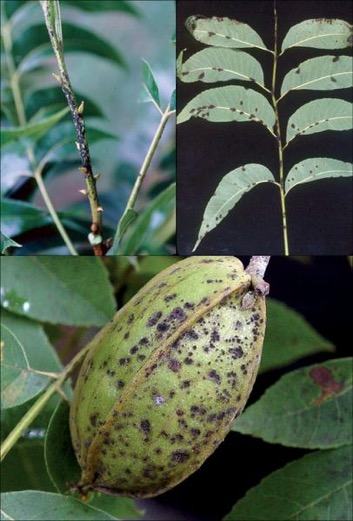
Scab is the common name and Cladosporium caryigenum is the fungal pathogen causing the destruction. Pecan Scab occurs on leaves, twigs, and nut shucks. Plant tissues are most susceptible when young and actively growing. Lesions usually begin as a small black spot, just 1 to 8 millimeters in size. These lesions may enlarge and coalesce, or come together, enveloping the entire leaflet and causing the leaflet to dry up and fall early. Scab frequently infects the shuck, which is the soft tissue surrounding the developing pecan. This infection causes the pecan to stop developing; the shuck will turn black and the nut will fall off the tree prematurely. This point of infection causes the heaviest loss in yield. Below are images of scab.